
Confused about Auto Glass Terms?
Auto Glass Terminology: Every Car Window & Glass Type Explained
★★★★★ Trusted by 1000+ DMV Drivers
When a window breaks or a windshield cracks, most people don’t know the right name for the glass they need — and that’s completely normal. “The little triangle window,” “the back windshield,” “the small window behind the door” — we hear descriptions like these every day, and our team always knows exactly what you mean. But knowing the correct terms can help you get a faster, more accurate quote and understand exactly what’s being replaced.
This guide breaks down every piece of auto glass on your vehicle, plus the industry terms you’ll hear during a repair or replacement. Whether you’re filing an insurance claim or just trying to describe what broke, this is your plain-English reference.
If you’d rather skip the reading, you can always just call AFG Auto Glass, describe the window in your own words, and we’ll identify it for you.
Part 1: The Windows On Your Vehicle
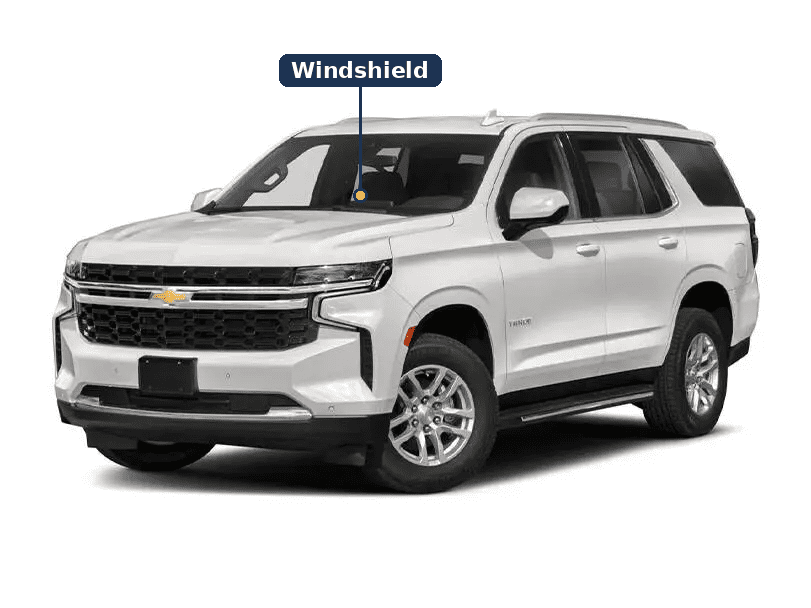
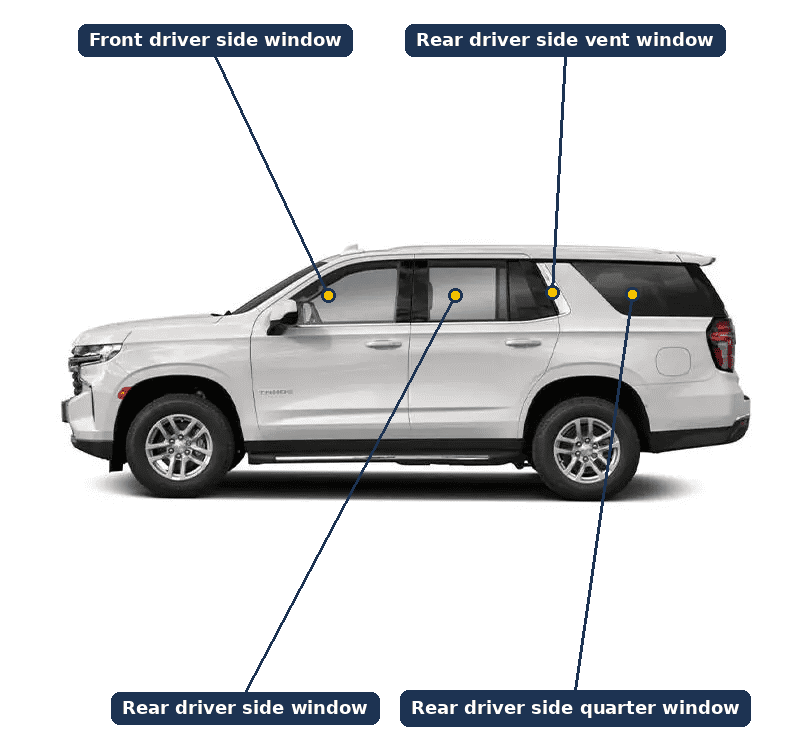
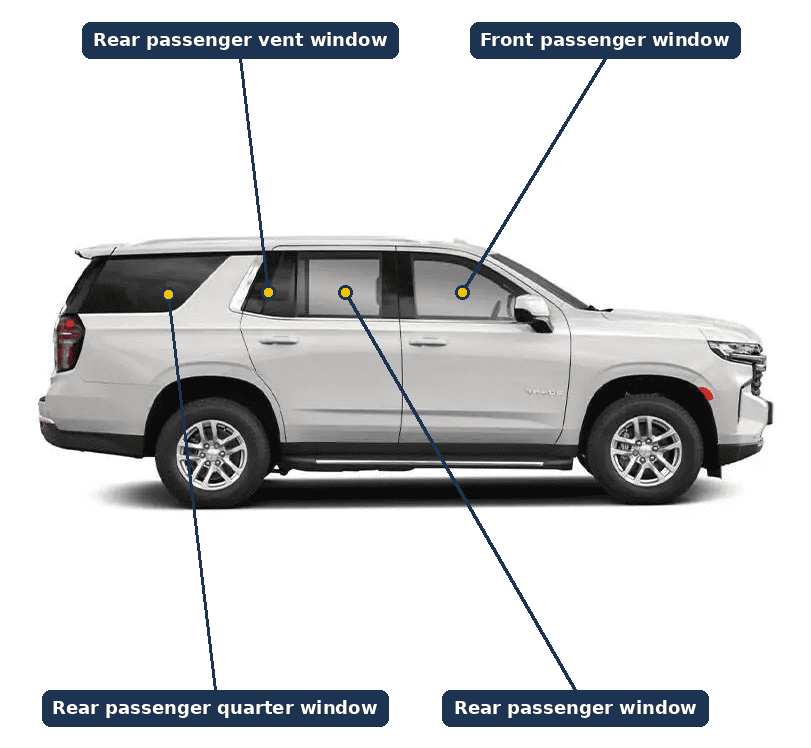
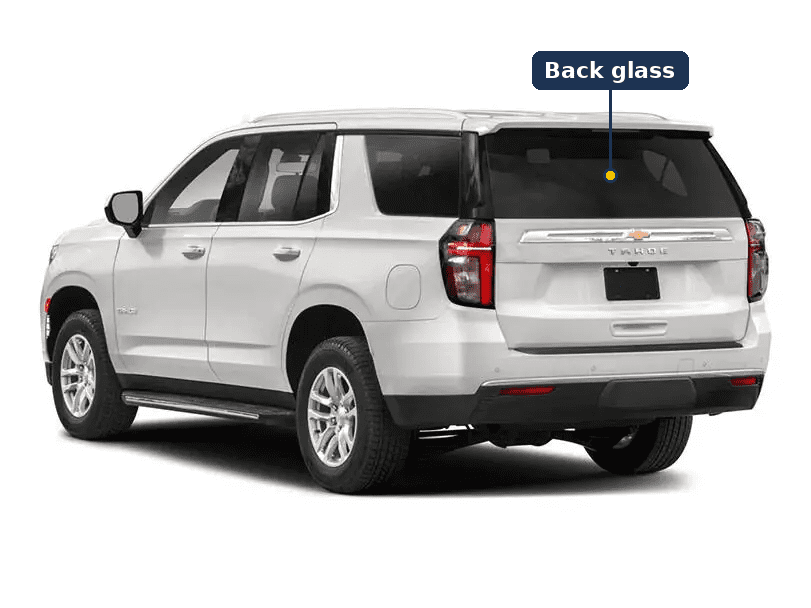
Windshield (Front Glass)
The windshield is the large glass panel at the front of your vehicle. It’s the most important piece of auto glass on your car — it’s a structural component that helps support the roof in a rollover and provides a backstop for the passenger airbag. Modern windshields are made of laminated glass (more on that below) and often house cameras, sensors, and other technology. This is the glass most people mean when they say “my windshield is cracked”. Services we offer: Windshield Replacement, Windshield Repair.
Back Glass (Rear Windshield)
The back glass is the large window at the rear of your vehicle. You’ll also hear it called the rear windshield or, in industry terms, the backlite. Unlike the windshield, back glass is usually made of tempered glass that shatters into small, blunt pieces for safety. Back glass often contains the rear defroster — those thin horizontal lines that heat up to clear fog and frost — which must be reconnected when the glass is replaced. Need a replacement? Click here!
Front Door Windows (Door Glass)
These are the roll-up/roll-down windows in your front doors — the front driver door window and front passenger door window. They’re the windows you lower at a drive-thru or toll booth. They’re made of tempered glass and are among the most commonly broken in break-ins. Need a front door window replacement? Click here!
Rear Door Windows
The roll-up windows in your back doors — the rear driver door window and rear passenger door window. On most sedans and SUVs these roll down; on some vehicles the rear door windows are partially fixed. Need a rear door window replacement? Click here!
Quarter Glass (Quarter Window)
The quarter glass is the small, often triangular or trapezoid-shaped window typically located toward the rear of the vehicle, behind the rear doors — or sometimes the small fixed window between the front and rear doors. The name comes from its position near the “quarter panel” of the car body. It’s usually a fixed (non-opening) window. Many people describe this as “the little window in the back that doesn’t roll down”. Need a quarter window replacement? Click here!
Vent Glass (Vent Window)
The vent glass is a small window, often triangular, usually located at the front edge of the front door windows (near the side mirror) or sometimes at the rear edge of the rear door windows. On older vehicles these were small windows that actually pivoted open for ventilation — hence the name. Today most are fixed. People often call this “the little triangle window by the mirror”. Need a vent window replacement? Click here!
Sunroof / Moonroof Glass
A sunroof or moonroof is the glass panel in your roof. (Technically a sunroof can be opaque and a moonroof is glass that lets light in, but the terms are often used interchangeably.) These are made of tempered or laminated glass and can crack or shatter like any other auto glass.
Side Mirror Glass
The small glass in your exterior side mirrors can also be chipped or broken and replaced — a smaller but common repair.
Part 2: The Types of Glass
Laminated Glass
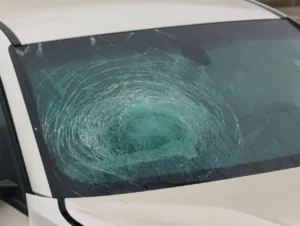
Laminated glass is made of two layers of glass bonded together with a clear plastic (PVB) layer in between. When it breaks, the plastic layer holds the pieces together instead of letting them fly apart — which is why a cracked windshield stays in one piece rather than shattering. Windshields are always laminated, and increasingly some side and rear windows are too, for safety and security.
Tempered Glass
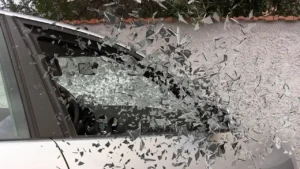
Tempered glass is heat-treated to make it much stronger than ordinary glass, and it’s designed to shatter into hundreds of small, blunt, pieces when it breaks (rather than sharp shards). Most side windows and back glass are tempered. This is why, when someone breaks into a car, the side window collapses into a pile of small cubes.
OEM Glass (Original Equipment Manufacturer)
OEM glass is made by (or for) the vehicle’s original manufacturer and matches the factory glass exactly. It’s typically the highest-cost option. (We explain this fully in our guide to OEM, OEE, and aftermarket glass.)
OEE / Aftermarket Glass
OEE (Original Equipment Equivalent) or aftermarket glass is made by a manufacturer other than the original, built to meet the same safety standards and fit. It’s a high-quality, lower-cost alternative to OEM glass.
Part 3: Auto Glass Features & Technology
Modern windshields are no longer just glass — they house cameras, sensors, projectors, and heating elements that power your vehicle’s safety and convenience systems. Here are the features and technologies you may have, and the terms you’ll hear.
ADAS (Advanced Driver Assistance Systems)
ADAS is the umbrella term for the suite of camera- and sensor-based safety systems built into modern vehicles. Many of these rely on a camera mounted to the windshield, which is why ADAS calibration is required after a windshield replacement on equipped vehicles. (See our full guide to ADAS calibration.)
Below are the individual systems that fall under ADAS. Note that automakers use different brand names for the same basic feature, so your owner’s manual may call it something specific to your make — but the underlying technology and calibration needs are similar.
Lane Departure Warning System (LDWS) — Alerts you when your vehicle drifts out of its lane without a turn signal. Uses the windshield camera to read lane lines.
Lane Keep Assist (LKA) / Lane Keeping System (LKS) — Goes a step beyond warning: actively steers or nudges the vehicle back into its lane. Also called Lane Centering or Lane Tracing Assist on some makes.
Forward Collision Warning (FCW) / Forward Collision Alert (FCA) — Warns you of an imminent collision with the vehicle ahead.
Automatic Emergency Braking (AEB) — Automatically applies the brakes to prevent or reduce a forward collision. Brand names include Mazda’s Smart City Brake Support (SCBS), Toyota’s Pre-Collision System, Honda’s Collision Mitigation Braking System (CMBS), Subaru’s EyeSight, and Nissan’s Forward Emergency Braking.
Adaptive Cruise Control (ACC) — Maintains a set distance from the car ahead, slowing and accelerating automatically. Often uses both the windshield camera and a front radar sensor.
Pedestrian Detection — Identifies people and cyclists in the vehicle’s path and can trigger warnings or automatic braking.
Traffic Sign Recognition (TSR) — Reads speed limit and other road signs through the windshield camera and displays them on your dashboard.
Auto High Beam / High Beam Assist — Automatically switches between high and low beams based on oncoming traffic, using the windshield camera and light sensor.
Driver Attention / Drowsiness Monitoring — Monitors driving patterns (and on some vehicles, the driver directly) to detect fatigue or distraction.
Windshield-Mounted Sensors
Rain Sensor — Detects rain on the windshield and automatically activates and adjusts your wipers. Mounted behind the glass, usually near the rearview mirror.
Light Sensor (Ambient Light Sensor) — Detects ambient light levels to automatically turn on your headlights and adjust dashboard brightness. Often combined with the rain sensor in a single rain/light sensor module.
Humidity Sensor — On some vehicles, detects cabin humidity to automatically manage defrost and climate settings.
Forward-Facing Camera — The central ADAS camera mounted behind the rearview mirror that powers lane, collision, sign, and high-beam systems. This is the component that requires recalibration after replacement.
Front Radar — Not on the glass itself (usually in the grille or bumper), but works together with the windshield camera for adaptive cruise control and collision systems.
Heating & Visibility Features
Heated Windshield / Heated Glass — Thin heating elements embedded in the windshield to melt frost and ice. (Distinct from the rear defroster.)
Heated Wiper Park — A heated zone at the bottom of the windshield where the wipers rest, preventing them from freezing to the glass in winter. Sometimes called a heated wiper park area or wiper de-icer.
Rear Defroster — The thin horizontal heating lines in the back glass that clear fog and frost. Must be reconnected when back glass is replaced.
HUD (Heads-Up Display) — Projects information such as speed and navigation directly onto the windshield in the driver’s line of sight. HUD-equipped windshields use special glass and must be matched exactly.
Acoustic Glass — A windshield with a sound-dampening inner layer that reduces road, wind, and engine noise inside the cabin. Common on luxury and newer vehicles.
Solar / Tinted / Infrared (IR) Glass — Glass treated to reflect heat and UV rays, keeping the cabin cooler and protecting the interior.
Antenna Glass — Some windshields and back glass have radio, GPS, or other antennas embedded in the glass rather than a traditional mast antenna.
Trim & Sealing Terms
Encapsulation / Molding / Trim — The rubber or plastic seal and trim around a piece of glass that holds it in place and keeps out water and wind. Damaged molding can cause leaks or wind noise, even if the glass itself is fine.
Why this matters for your replacement: The more of these features your windshield has, the more important it is that the replacement glass matches your vehicle exactly — and that any cameras and sensors are recalibrated afterward. When you call, tell us your vehicle’s year, make, model, and any technology packages (lane assist, automatic braking, HUD, heated glass, cold-weather package), and we’ll source the exact glass and handle any required calibration.
We're Always Here To Help
Still not sure what you need? Just describe it.
You don’t need to memorize any of this. Our team identifies the exact glass you need every day — from “the triangle window by the mirror” to “the back windshield with the lines in it.” Tell us your vehicle’s year, make, and model and describe what broke, and we’ll handle the rest.
AFG Auto Glass has served Northern Virginia, Washington DC, and Maryland since 1999 with same-day mobile service, OEM and OEE glass for every window on your vehicle, a lifetime warranty, and direct insurance billing.